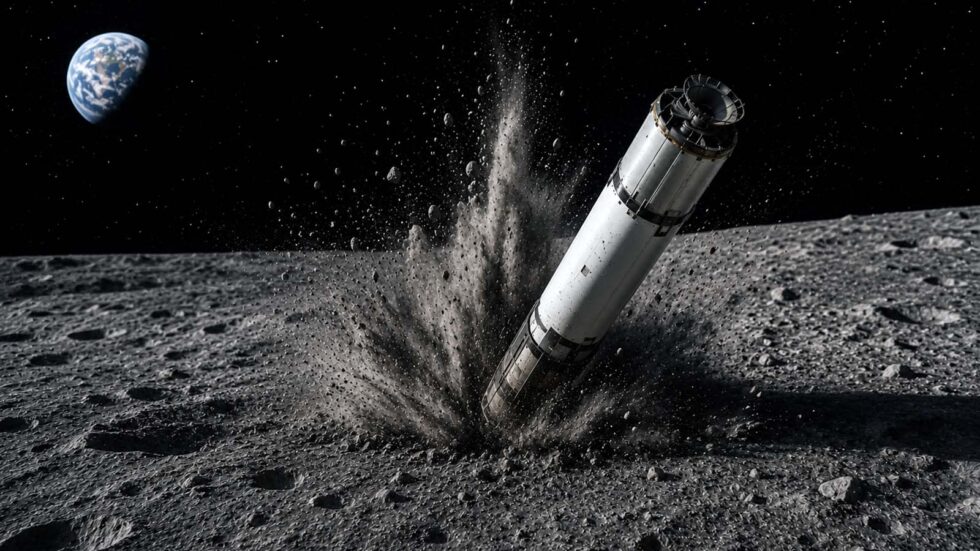

After wandering aimlessly in deep space for a year and a half, an upper-stage booster of a SpaceX Falcon 9 rocket has collided with the Moon. The roughly five-story-tall, 4000-kilogram rocket booster was originally launched in January 2025 as part of a joint lunar mission between the United States and Japan. While the first stage of the rocket returned to Earth, the second stage remained stranded in space, and over the last 18 months, gravitational pulls from the Sun and the Moon altered its trajectory, ultimately driving it into the lunar surface.
Addressing the incident, Juliana Schein, Director of NASA Science and Dragon Programs at SpaceX, explained that while low-Earth orbit debris is typically burned up in Earth’s atmosphere, high-energy missions require different protocols. Although safety procedures were followed during this launch, complex gravitational shifts and solar activity redirected the debris. Fortunately, experts have confirmed that Earth faces no danger or threat from this collision. Instead, scientists view the impact as a valuable research opportunity to study lunar surface dynamics and the behavior of space debris.