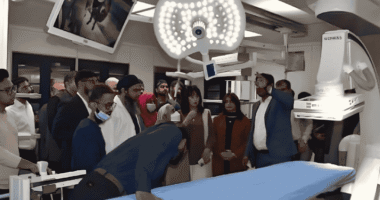

KARACHI: The National Database and Registration Authority (NADRA) has officially expanded its footprint in Karachi by inaugurating its fifth Mega Center in Surjani Town, launched under the auspices of the Governor of Sindh. This state-of-the-art facility is strategically designed to provide uninterrupted, 24/7 registration services to a massive population of four million residents from Surjani Town and its surrounding areas. Operating seamlessly across three daily shifts, the center is equipped with twenty one-window counters and a spacious waiting area that can accommodate two hundred people simultaneously, enabling it to facilitate up to twenty-five hundred citizens on a daily basis.
In a pioneering move toward absolute inclusivity, the center has introduced modern technological upgrades, including four specialized tablets equipped with advanced biometric fingerprint and iris-scanning systems dedicated exclusively to senior citizens and specially-abled individuals. Furthermore, the facility breaks new ground by integrating a welfare-centric Thalassemia Desk, which is set to provide visitors with free-of-cost screening and diagnostic services. During the inauguration, the Governor of Sindh lauded these advancements, noting that NADRA’s transition toward digital modernization and public health initiatives represents a revolutionary step in delivering public services directly to the citizens’ doorstep.
Looking ahead, NADRA is aggressively pursuing regional expansion and digital integration to further ease public accessibility. Director General NADRA Karachi Region, Aamir Ali Khan, confirmed that new centers in Gulberg, Korangi, and Model Colony are being constructed on a priority basis and will open soon. To manage current influxes, the operational hours at the Gulshan-e-Hadid, Landhi, Orangi, and Awami Markaz centers have already been upgraded to double shifts. Most notably, NADRA’s Vision 2027 aims to fully integrate the Pak-ID system with local Union Councils, a landmark digital upgrade that will ultimately empower citizens to secure vital documents like marriage, birth, and death certificates remotely without ever needing to physically visit a UC office.